אוקטובר 2026
-ed and -s endings
Two small endings carry a lot of grammar in English: -ed for the past (walked, played, wanted) and -s for plurals and present verbs (cats, she works). Each has three pronunciations, and both are short sounds that are easy to miss in speech.
How to pronounce -ed: three sounds
Listen to the endings in these examples. The sound before -ed determines which pronunciation you hear.
- Walked, stopped, watched.
- Played, called, cleaned.
- Wanted, needed, started.
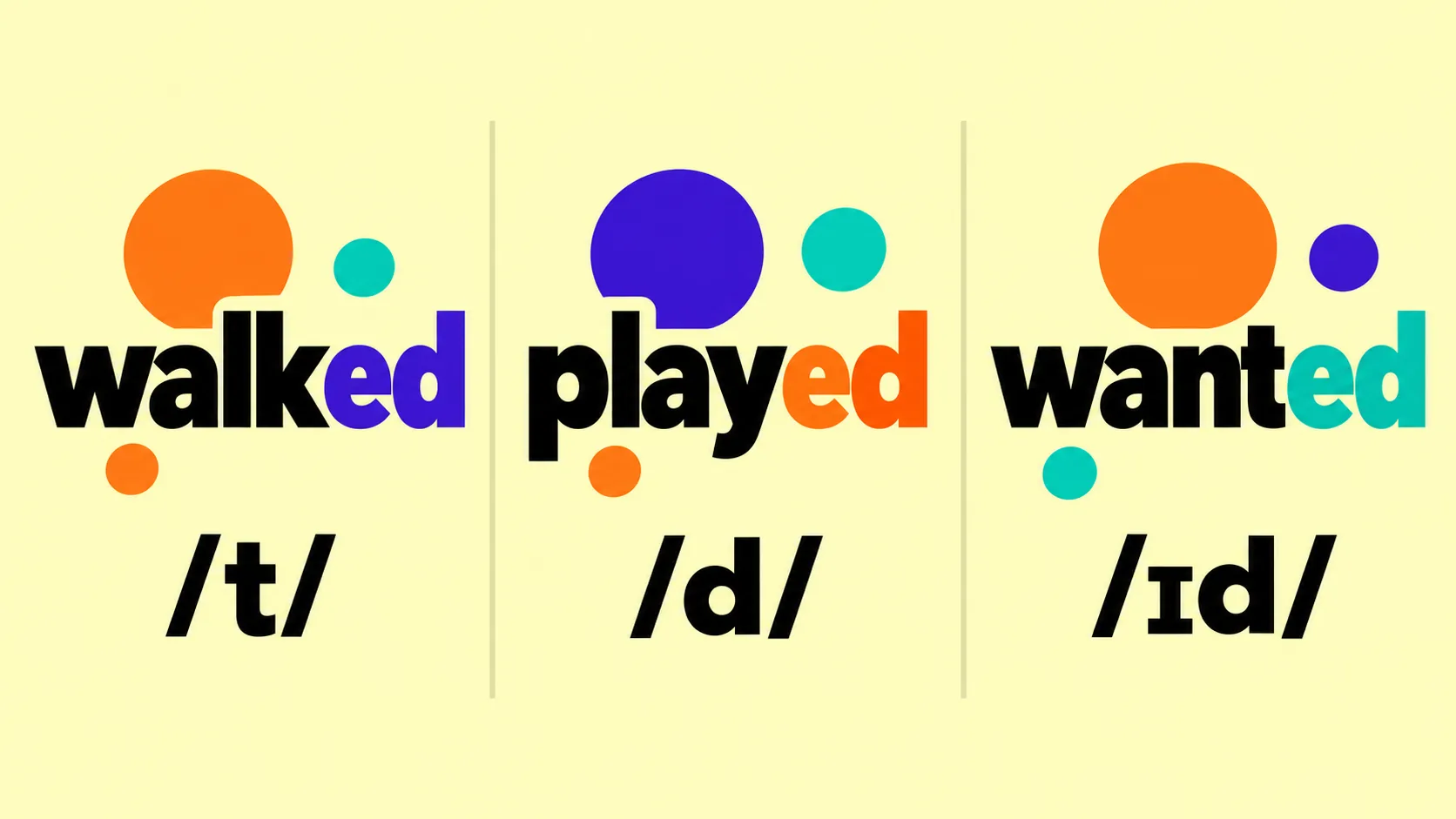
- /t/ after voiceless sounds (p, k, f, s, sh, ch): walked, stopped, laughed, missed, washed, watched.
- /d/ after voiced sounds and vowels: played, called, opened, lived, cleaned, cried.
- /ɪd/, an extra syllable, after t and d: wanted, needed, started, decided, waited.
The -ed rule in one line
Only verbs that end in a t or d sound get an extra syllable (/ɪd/). For all the others, -ed adds no syllable: “walked” is one syllable, not “walk-ed”. Put your hand on your throat: if the last sound of the verb buzzes (voiced), -ed is /d/; if it doesn’t (voiceless), it is /t/.
How to pronounce -s: three sounds
Listen to each group. The final sound of the base word determines how the ending is pronounced.
- Cups, cats, books.
- Dogs, bags, trees.
- Buses, wishes, watches.
- /s/ after voiceless sounds (p, t, k, f): cups, cats, books, laughs.
- /z/ after voiced sounds and vowels: dogs, bags, plays, trees.
- /ɪz/, an extra syllable, after s, z, sh, ch, j sounds: buses, roses, wishes, watches, pages.
What the -s does
- Plural nounsone book, two books.
- Present-tense verbs after he, she or it: I work, she works.
- Possessivesthe teacher’s desk, my parents’ house.
What learners miss most
Endings that add no syllable can be hard to hear, especially when they link to the next word. For example, you might hear: “She work in a bank” for “She works in a bank”, “two cat” for “two cats”, “I walk home yesterday” for “I walked home yesterday”. The extra syllable in /ɪd/ and /ɪz/ can make those endings easier to notice.
How to catch the endings
- Use time words: “yesterday”, “last week” or “ago” can suggest a past verb. Regular past verbs take -ed; irregular verbs have other forms.
- Use the subject: after “he”, “she” or “it” in the present, the verb needs -s; after “two”, “many” or “some”, the noun usually needs it too.
- Listen for the link: “walked out” often sounds like “walk tout”, “works in” like “work sin”. The ending can link to the next word.
- Check your writing before you send it: every past verb, every plural, every he/she/it verb.
Questions about -ed and -s endings
What are the three ways to pronounce -ed?
/t/ after voiceless sounds (walked), /d/ after voiced sounds (played), and /ɪd/ after t and d (wanted).
When is -ed pronounced as an extra syllable?
Only after verbs ending in a t or d sound: wanted, needed, started. Everywhere else, -ed adds no syllable.
How is the -s ending pronounced?
As /s/ after voiceless sounds (cats), /z/ after voiced sounds (dogs), and /ɪz/ after s, z, sh, ch and j sounds (buses, watches).
Why do I miss these endings when I listen?
They are very short sounds at the end of a word, often joined to the next word, and many languages don’t mark the past or plurals this way. Your ear has to learn to expect them.